e

Thứ Hai, tháng 7 15, 2013

Bài thơ hay

Bài thơ đầu anh viết tặng em
Là bài thơ anh kể về đôi dép
Khi nỗi nhớ ở trong lòng da diết
Những vật tầm thường cũng biến thành thơ

Hai chiếc dép gặp nhau tự bao giờ
Có yêu nhau đâu mà chẳng rời nửa bước
Cùng gánh vác những nẻo đường xuôi ngược
Lên thảm nhung xuống cát bụi cùng nhau

Cùng bước mòn, không kẻ thấp người cao
Cùng chia sẻ sức người đời chà đạp
Dẫu vinh nhục không đi cùng người khác
Số phận chiếc này phụ thuộc chiếc kia

Nếu ngày nào một chiếc dép mất đi
Mọi thay thế đều trở nên khập khiễng
Giống nhau lắm nhưng người đời sẽ biết
Hai chiếc này chẳng phải một đôi đâu


Cũng như mình trong những lúc vắng nhau
Bước hụt hẫng cứ nghiêng về một phía
Dẫu bên cạnh đã có người thay thế
Mà trong lòng nỗi nhớ cứ chênh vênh

Đôi dép vô tri khắng khít song hành
Chẳng thề nguyền mà không hề giả dối
Chẳng hứa hẹn mà không hề phản bội
Lối đi nào cũng có mặt cả đôi

Không thể thiếu nhau trên những bước đường đời
Dẫu mỗi chiếc ở một bên phải trái
Nhưng tôi yêu em ở những điều ngược lại
Gắn bó đời nhau vì một lối đi chung

Hai mảnh đời thầm lặng bước song song
Sẽ dừng lại khi chỉ còn một chiếc
Chỉ còn một là không còn gì hết
Nếu không tìm được chiếc thứ hai kia
                         
Thơ của Nguyễn Trung Kiên

Thứ Bảy, tháng 7 13, 2013

BOND girl band + Andre Rieu orchestra : VICTORY !

Thứ Năm, tháng 7 11, 2013

Khả năng giữ thăng bằng của đá do Thiên Nhiên


Có thể được tìm thấy ở Khu vườn của các vị thần tại Vườn quốc gia tự nhiên
 nằm gần đỉnh Pike tại Colorado Spings, Colorado, tảng đá nằm án ngữ gần
 ngay mặt đường, to lớn sừng sững, tạo cảm giác nó chỉ đang tựa hờ vào 
điểm tựa và có thể đổ ụp xuống đường bất cứ lúc nào.
May thay là cho đến bây giờ nó vẫn “hiên ngang” đứng gác ở đó, chưa
 có dấu hiệu gì xuy chuyển tuy nhiên cũng quả là “thót cả tim” cho 
những ai lần đầu đi qua con đường này.
Digby, Nova Scotia (Canada)
Hòn đá được tìm thấy ở Digby, Nova Scotia, là một cột đá núi lửa hình trụ
 cao gần 9 m đứng cheo leo nơi vách núi với bề mặt đá đã dần dần bị xói 
 mòn qua năm tháng.
Theo lời của các vị khách đến thăm quan nơi đây thì quả là thực sự 
kinh ngạc khi được tận mắt ngắm nó ở cự li gần. Cột đá gần như
 không mấy liên kết với bệ đá đang đỡ nó, không những thế một 
phần của nó còn trồi hẳn ra bên ngoài. Không có một lực hay vật gì 
chống đỡ nhưng nó vẫn đứng đó đầy hiên ngang, như thách thức
với đất trời.
Idol Rock, Brimham Moor, Bắc Yorkshire (Anh)
Tại Brimham Moor ở Bắc Yorkshire, Anh, chúng ta có thể tìm thấy rất
 nhiều khối đá với hình dáng kì lạ và nổi bật trong số đó về khả năng
 “giữ thăng bằng” hiếm có là một tảng đá có tên là “ Idol Rock”.
Ước chừng nặng khoảng 200 tấn, Idol Rock cân bằng trọng lượng to lớn
 của nó trên đỉnh một hòn đá chóp nhọn giống hình một chiếc kim tự tháp,
 trông vô cùng nhỏ bé hơn so với cái khối khổng lồ mà nó đang mang 
trên mình.
El Torcal de Antequera, Andalucia ( Tây Ban Nha)
Khu bảo tồn thiên nhiên El Torcal nằm ở vùng núi phía Nam Antequera, 
Tây Ban Nha có một số lượng lớn các khối đá vôi bị bào mòn bởi tự nhiên
 thành những hình dạng vô cùng độc đáo.
Chúng là những ngọn tháp đá lớn, nhìn giống như nhiều tảng đá được
 xếp chồng lên nhau một cách ngay ngắn bởi bàn tay con người, tuy 
nhiên chúng hình thành hoàn toàn là do tự nhiên và gắn kết với nhau
 rất chặt chẽ. Với kết cấu đa dạng, hình thù lạ mắt, những ngọn tháp
 đá này quả thực là một kì quan “sắp đặt” tuyệt mỹ của tự nhiên.
Kjeragbolten (Na Uy)
Kjeragbolten là một khối đá lớn có đường kính khoảng 5m2 nằm 
“rúc mình” trong chỗ nứt giữa hai hòn đá khổng lồ tại núi Kjerag, 
Na Uy. Nằm ở độ cao khoảng 1.000 m, với những ai có can đảm 
để đi bộ qua tảng đá thì đây là một chỗ lí tưởng để phóng tầm mắt 
nhìn ngắm cảnh đẹp xung quanh và cả cảnh quan ngoạn mục khi 
nhìn từ trên cao xuống đáy thung lũng. Còn với những ai mắc căn 
bệnh sợ độ cao hay “yếu bóng vía” có lẽ chỉ nên đứng từ xa ngắm 
 nó thôi cũng là đã đủ tuyệt vời rồi.
Peyro Clabado, Sidobre (Pháp )
Peyro Clabado (Nailed Rock) có lẽ là khối đá granit nổi tiếng nhất được 
hình thành bởi tự nhiên sau đó bị xói mòn thành hình dáng hiện nay 
trong khu vực Sidobre ở Languedoc nước Pháp. Tất cả đá ở đây là 
những gì còn xót lại của một dãy núi khổng lồ có tuổi đời từ hơn
 300 triệu năm trước.
Dù đá granit cực kì cứng và to lớn nhưng theo thời gian, nó cũng sẽ 
trở về thành cát bụi và trầm tích. Cho đến khoảnh khắc đó thì chúng 
ta đang có đặc quyền được ngắm khối đá khổng lồ nặng 780 tấn này
 thực hiện một màn trình diễn “giữ thăng bằng” đầy ngoạn mục.
Đá nấm, Kansas (Mỹ)
Công viên đá nấm, được đặt tại vùng đồi Smoky của Kansas, có diện
 tích vỏn vẹn là 0.02 km2 nhưng những tảng đá đặc trưng mang hình
 cây nấm có tuổi đời lâu nhất trên Trái đất đã tạo nên nét đặc trưng 
độc đáo của nó.
Mặc dù tình trạng bị phân hủy bởi gió và nước diễn ra tương đối chậm
 nhưng tác động rõ rệt của nó có thể nhìn thấy được qua một thời gian
 dài. Quan sát phần thân của những tảng đá nấm tại đây, ta có thể thấy
 rõ từ những khối đá sa thạch Dakota rắn chắc, đen xì bị bào mòn đã trở 
nên bé hơn, màu sắc sáng ra trông thấy. Phần thân trụ to lớn trước kia 
nay chỉ còn là những bệ đá mỏng dẹt.  
Chiremba, Epworth (Zimbabwe)
Những tảng đá thăng bằng Chiremba ít được biết đến ngoài biên giới 
của Zimbabwe nhưng người dân nơi đây đặc biệt coi trọng vẻ uy nghi
 của chúng, thậm chí họ còn lấy nó làm biểu tượng trên tờ tiền giấy 
của đất nước mình. Giống những tảng đá tại Sidobre, Pháp, những 
tảng đá tại đây là loại đá granit cổ đại và cũng mất hàng triệu năm 
để cố định hình dạng “bấp bênh” của chúng như ta có thể thấy trong 
những bức ảnh.
Epworth nằm cách xa vài dặm về phía Đông Nam thủ đô của Zimbabwe, 
Harare và khu vực đá Chiremba cách đó chỉ bằng một chuyến xe taxi ngắn. 
Nơi đây đã được chính thức công nhận là di tích quốc gia vào năm 1994
 và trở thành một địa điểm thăm quan cho du khách gần xa.
Đá mũ Mexico, Utah (Mỹ)
Tảng đá mũ Mexico nằm ngay bên ngoài thung lũng Monument ở phía 
Nam trung tâm San Juan County, Utah. Phiến đá sa thạch đỏ cao 18 m,
 rộng khoảng 3.7 m này là “độc nhất vô nhị” trong khu vực và có thể nhìn 
thấy từ xa hơn trăm dặm xung quanh.
Có hai tuyến đường leo dành cho những người muốn tận mắt chiêm 
ngưỡng cảnh tượng độc đáo này tuy nhiên người ta cũng khuyến cáo
 rằng tảng đá mũ Mexico được gắn với bệ đá đỡ chỉ bằng một khoảng
 eo đá rất bé nên có lẽ không sớm thì muộn nó cũng sẽ gãy đôi khi áp
lực phải chịu là quá lớn. 
(Sưu tầm )

Thứ Hai, tháng 7 08, 2013

Pioneering renewable energy options: Thailand takes up the challenge

 windturbine

 Thailand’s electricity challenges and the potential of renewable energy
Thailand’s support policies for renewable energy (RE) in the power sector have allowed individual small projects to add up to something substantial, attracting more investment and leading to faster growth in the sector than in most other Asian nations. Thai energy policy is complex, and the development of RE has not been without controversy. While this brief provides some elements of the context necessary to understand renewable electricity promotion policies, it cannot cover all aspects of Thai energy policy. Instead it focuses on identifying factors that can explain the relative success of Thai policies and highlights some lessons for future development.
Download the Inside Story
Key messages
  • Thailand was among the first countries in Asia to introduce incentive policies for the generation of electricity from renewable energy (RE) sources, leading to rapid growth, particularly in solar power.
  • Programmes for small and very small power producers created predictable conditions for RE investors to sell electricity to the grid. The ‘Adder’, a feed-in-premium, guarantees higher rates for RE, making the investments profitable. Thailand also regularly updates technical regulations, provides preferential financing, and invests in research and training.
  • Civil society involvement strengthened and improved RE policies. In Thailand, outside expertise and links to international networks brought by civil society experts were crucial for the design and approval of the incentive measures.
  • The Thai government is now adapting its policies to take account of recent technological progress and market growth. It is considering a sophisticated feed-in tariff to better control costs, while continuing to offer an enabling environment for RE investments.
Thailand has a large-scale centralised power system with a high electrification rate and high per capita energy demand compared with neighbouring countries in South-East Asia (Table 1).
Table 1: Key energy statistics for Thailand and its neighbours, 2010 (2009 for electricity access)
  Population GDP (current US$) Energy use (kg of oil equivalent per capita) Electric power consumption(kWh per capita) Access to electricity (% of population)
Thailand
69 million
$318.9 billion
1698.9
2243.4
99.3%
Cambodia
14 million
$12.8 billion
355.4
146.1
24%
Lao PDR
62 million
$7.1 billion
 –
–
55%
Malaysia
28 million
$246.8 billion
2557.8
4117.4
99.4%
Myanmar
48 million
 –
291.8
131.1
13.1%
Viet Nam
87 million
$106.4 billion
681.4
1034.7
97.6%
Source: World Bank, World Development Indicators, World DataBank
The Thai power sector faces several challenges:
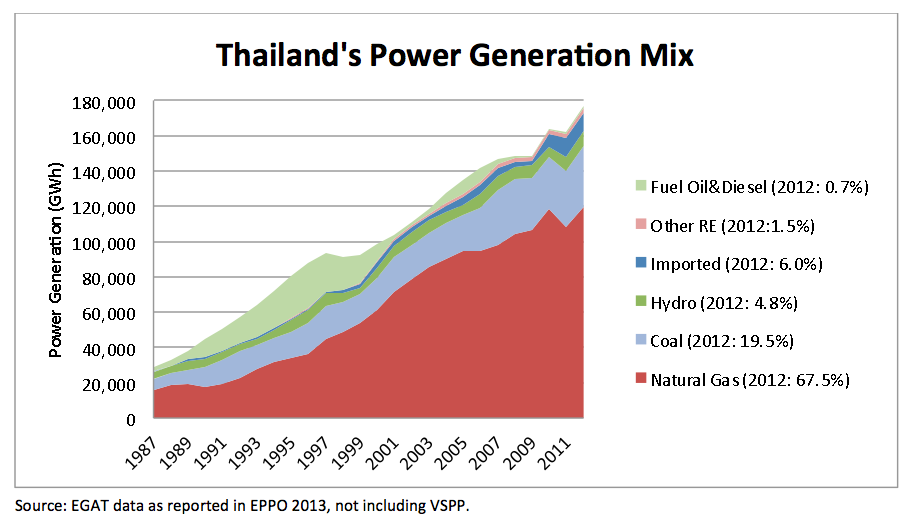
1)     Thailand is dependent on energy imports. The Thai electricity mix is dominated by natural gas, providing around 70% of electricity (see Figure 1). Even though Thailand exploits its domestic fossil fuel reserves, it is still highly import-dependent, importing almost 25 percent of its natural gas supply and over 50 percent of its primary energy supply (measured in tons of oil equivalent) in 2011.  The dependence on controversial electricity imports from Laos, natural gas imports from Myanmar, and volatile global fossil fuel markets risks undermining energy security of supply. Energy imports also represent an economic burden for the country, consuming almost 12% of GDP.

ThailandsPowerGenerationMix
2)    Thailand needs to provide for the growing electricity needs of its citizens and its economy. On average, over the last 5 years, electricity consumption has grown by 3.3% per year. Civil society and researchers have accused the government of overstating future demand in order to justify new large hydro, coal or nuclear power plants. There is significant potential for efficiency measures. Experience from the past shows that demand growth has consistently been overestimated in official projections. Nonetheless, official and alternative scenarios agree that some additional capacity will be needed in coming years as electricity demand grows.
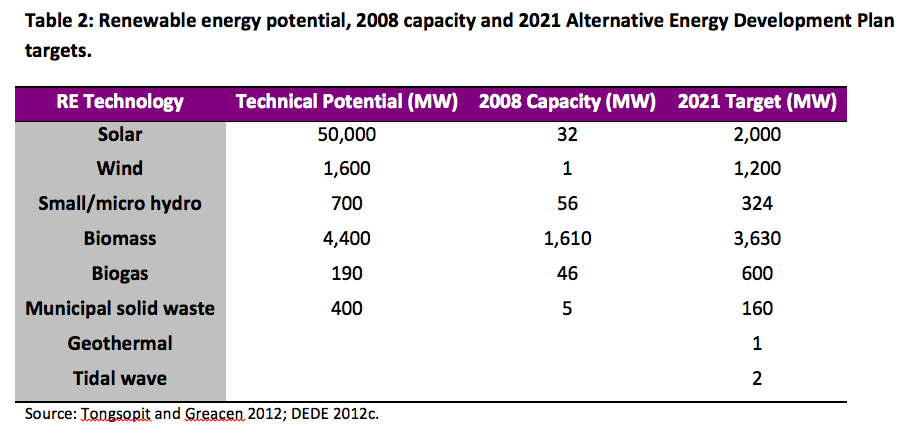
3)   Thailand recognises the need to reduce pollution and greenhouse gas emissions. The 11th National Economic and Social Development Plan, a 5-year framework guiding government policy, includes the objective to move “toward a low-carbon society”. The power sector was responsible for 42% of greenhouse gas emissions in 2011 and will have to make a significant contribution to achieve this objective.Renewable energy sources can be an important part of the answer to these challenges. Resource assessments show a large potential for a number of RE technologies (see Table 2). This is why the Thai government passed the 15-year Renewable Energy Development Plan (2008–2022), setting a target of achieving 20% of RE in final energy consumption. At the end of 2011, the 10-year Alternative Energy Development Plan (2012–2021) increased these targets to 25% in total energy consumption and 10% in electricity consumption (see Table 2).
The Thai government estimates that achieving these targets would:
  • avoid over US$19 billion in energy imports annually
  • encourage around US$15 billion in private investment
  • avoid 76 million tons of greenhouse gas emissions per year
  • create at least 40,000 new jobs
  • generate extra income and employment in rural areas.
Table2 
The structure of the Thai electricity sector
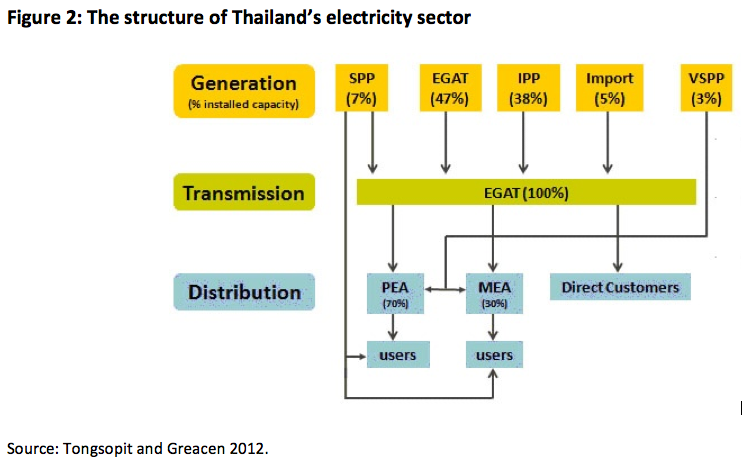
Since the 1990s, successive governments have taken steps to open the Thai electricity market to private investors. Attempts to privatise the state-owned Electricity Generation Authority of Thailand (EGAT) met with resistance and were eventually abandoned. As a consequence, Thailand’s electricity market is now characterised by both a contribution from private power generators and a strong role for the state-owned utilities. EGAT owns around 50% of electric generation capacity, purchases electricity from Independent Power Producers (IPPs) and Small Power Producers (SPPs) and operates the country’s entire transmission infrastructure. Electricity is distributed to the consumers by two public distribution companies: Metropolitan Electricity Authority (MEA), serving the Bangkok area, and Provincial Electricity Authority (PEA), serving the rest of the country.
StructureOfThaiElectricity
A policy mix to promote renewable energy
In 1992, Thailand introduced the Small Power Producer (SPP) programme. It obliged EGAT to purchase power from power plants that combined heat and power generation or ran on renewable sources, under transparent and predictable power purchase agreements (PPAs). Power plants with a capacity to export up to 60 MW to the grid – later increased to 90 MW – were eligible. For power plants the government classified as ‘firm’, mostly based on fossil fuels as well as biomass, 20–25 year PPAs were signed. ‘Non-firm’ plants, including most RE projects received 1–5 year contracts. The power was purchased at a rate that reflected the avoided cost, i.e. the cost EGAT would have had to incur to generate the same amount of power. The programme mainly benefitted cogeneration plants using fossil fuels. The SPP program also allowed the development of some plants using waste biomass, such as bagasse, paddy husks or woodchips, to compete. Other RE sources were not competitive at the offered rates.
In 2001, a Very Small Power Producer (VSPP) programme was introduced for RE plants with an export capacity of up to 1 MW (later increased to 10 MW). VSPPs benefited from simplified regulations and were able to sell power directly to the distribution companies MEA and PEA. The rate they received also reflected avoided costs: the distribution companies paid the same wholesale rate to VSPPs as they would have paid to purchase electricity from EGAT’s transmission network.
The VSPP programme started slowly, with a few projects with a total capacity of 16 MW being connected to the grid in the first 5 years. This allowed the utilities to get familiar with the programme and showed that RE could work. In 2006, the government further streamlined the procedures and introduced the ‘Adder’.
The Adder is a feed-in premium paid to SPPs and VSPPs using RE on top of the avoided cost rate. It ranges from around 8 to 21 US cents per kilowatt hour (kWh) and is paid for 7–10 years, depending on the technology. It is funded through a small surcharge per kWh paid by all electricity consumers. The Adder is technology specific, reflecting differences in generation cost. For example, the Adder for solar energy is higher than for biomass. An additional premium is paid to projects that replace diesel generators in remote areas or are located in three southern provinces.
The SPP and VSPP programmes provided power producers with certainty that they would be able to sell their power to the grid. The process was simple, using standardised PPAs and interconnection procedures. Utilities were the single point of contact, responsible for processing and approving applications, based solely on the availability of the grid. The Adder provides additional certainty by providing a fixed additional payment. The attractive rates, coupled with a simple rate structure, make it easy for investors to develop viable business plans.
Other government measures complement these programmes. Regulations dealing with the technical challenges of RE sources are being updated periodically. Public universities and research institutes are exploring improvements in RE technology. Through incentives administered by the Board of Investments, eligible RE projects can get a corporate income tax break for up to 8 years and are exempt from import duties on equipment. A revolving fund, funded through a tax on all petroleum products sold in Thailand, provides financing to local banks so that they can pass on low-interest loans with a maximum interest rate of 4% to RE projects. Another government fund provides equity investment or venture capital of up to 50 million Baht (US$1.7 million) for smaller RE projects, as well as technical assistance and support for developing and selling carbon credits. International financial institutions, such as the World Bank or the Asian Development Bank also finance RE projects in Thailand.
Why did it happen in Thailand?
Thailand is a pioneer of ambitious RE policies in the region. Introducing these policies was not easy in a country heavily reliant on fossil fuels, with growing demand for electricity and very powerful utilities. A few elements that help explain what made it possible include the following:
  • Renewable energy policies were aligned with broader political priorities, beyond environmental considerations. Energy security was an important driver for the introduction of the SPP and VSPP programmes. In the context of the struggle over electricity sector deregulation between the government owned utilities and private companies, the programmes also seemed acceptable to both sides: they encouraged some private participation in the sector, yet were small enough not to seem threatening to the utilities.
  • Civil society groups played a crucial role in the design of the VSPP and the Adder. There was limited expertise on RE within the Thai electricity sector. Civil society input brought in expertise on RE and on regulations that had worked in other countries. For instance Palang Thai, an NGO working on rural electrification, convened roundtables of regulators, utilities and RE experts and organised study tours in Thailand and abroad to showcase successful RE projects. They also prepared studies showing that RE can make a much larger contribution to meeting Thailand’s electricity demands than was projected in the official plans. Civil society groups identified the RE champions in government agencies and used meetings and study tours to help break down the silos between different agencies and utilities. Members of this informal coalition of RE proponents were at the table when regulations were drafted and approved.
  • The Thai programmes started small and grew over time. When the VSPP programme was introduced, proponents could point to the existing SPP programme as a precedent. Because of their limited size and costs, the first few VSPP projects were seen as easy to manage and integrate into the grid, making utility engineers more willing to accept them. When the extension of the VSPP programme and the Adder were proposed, proponents could point to these existing projects, which were working well. Starting small also allowed constituencies to form, who benefited from the programme and subsequently pushed for its extension.
The impact of Thailand’s renewable energy policy
Thailand’s RE promotion policies supported the emergence of a new type of electricity projects: decentralised RE projects that are not owned and operated by large utilities, but by rice mill owners using the energy contained in rice husks, factory managers turning waste streams into a new source of revenue and domestic and international investors developing solar farms. By the end of 2011, over 260 RE plants were operational under the SPP and VSPP schemes, with a generating capacity of roughly 1 GW. Another 8 GW are at various stages of the project pipeline, though it is not clear that all of them will be built. Taking other sources – such as plants operated by the utilities themselves and off-grid installations – into account, Thailand had managed to develop a total RE capacity of almost 2.2 GW within a few years.
The policy support for RE has encouraged significant investments: US$1.5 billion were invested in the Thai RE sector in 2011. There is also a domestic RE equipment manufacturing industry emerging. For instance, Thailand now has three companies manufacturing solar cells and modules using imported wafers, and another three assembling imported cells into modules. In addition, there are a number of components and services that can be supplied by Thai firms. On average, 70–80% of the equipment used in solar projects (by value) is still being imported and additional steps and policy stability will still be necessary to build a stronger domestic industry.
Current challenges and the way forward for Thailand’s renewable energy policy
By 2010, attractive Adder rates and falling global prices for solar power equipment led to applications for more than 2,000 MW of solar projects, exceeding the official target (500 MW at the time) by a factor of four. There were concerns that some applications were speculative and that the impact on consumer bills would be too high if most of these projects were built, because the cost of the Adder are passed through to all electricity customers. In 2010, the government therefore reduced the Adder for solar projects that had already submitted applications but not signed a PPA, and put a hold on accepting new applications. Final project approval was moved from the utilities to a new committee, composed of government and utility representatives. The committee introduced additional approval criteria, including access to land, financing and necessary permits. For applicants, this change has meant less certainty and the number of applications has essentially stalled.
Thailand remains committed to scaling up RE, as reflected in the increased targets approved in 2011. According to the government, the hold on solar applications is a temporary measure, while a new support policy is being developed. The policy will need to address three issues to ensure long-term success:
1)   Integrating RE in overall energy planning: The Power Development Plan (PDP 2010–2030) forecasts future demand and the need for additional generation capacity, with a focus on large hydro, fossil fuel and nuclear plants. The PDP projects relatively low levels of RE that seem inconsistent with the rapid growth of the sector. Since the early 2000s, civil society groups have been calling for a more transparent and participatory planning process and challenging the PDP’s assumptions on demand growth and the potential contribution of RE. The government has agreed to transparently monitor the actual generation of existing RE plants and the plan might be adjusted as a result.
2)   Adapting to falling costs: Thailand needs to find a way to manage the cost of its incentive programmes without making a formerly simple support scheme unpredictable. That would stall growth, as has happened since 2010. The government has decided to move from a feed-in premium to a feed-in tariff (FIT). This would be different from the current Adder in that it would not just guarantee the premium paid on top of the avoided cost, but guarantee a total rate paid to VSPPs and SPPs, independent of volatile conventional power price. Thailand is also considering adopting features of successful FITs in other countries. For example, the new scheme could provide a pre-determined schedule for reductions in the FIT rate. Regular reviews, using clearly defined methodologies, could provide a transparent framework for revisions.
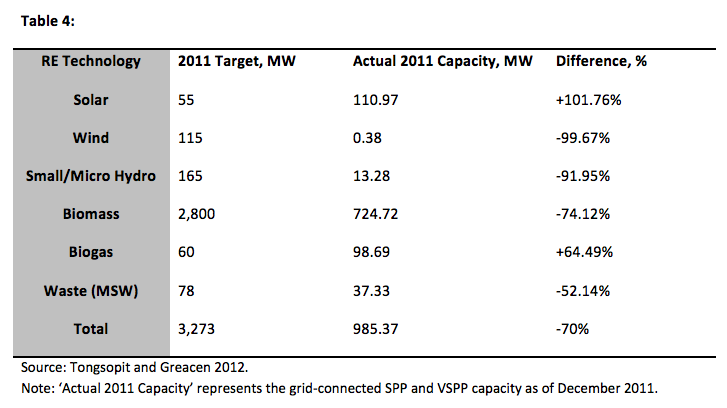
3)   Ensuring a balanced RE portfolio: Table 4 compares the 2011 targets from the REDP to actual installations – it shows that while solar power and biogas were well ahead, all other sources were lagging behind. The explosive growth in solar PV may overshadow the fact that the development of other RE sources has been slower than planned, which will also make it difficult to achieve the positive development impacts in terms of avoided exports or job creation. The incentives for technologies other than solar might have to be increased. Likewise, additional incentives might be needed to encourage projects that benefit smaller projects or rural communities. So far, financing, even from public sources, has focused on existing companies with a strong balance sheet; securing project financing has remained difficult for communities or for new companies focused on RE. The existing policy mix has helped stimulate capital-intensive, private sector-oriented investments. Specific incentives for rooftop solar or rural communities could encourage a more balanced portfolio.
 

Thứ Bảy, tháng 7 06, 2013

Welcome to Viet Nam (VN traditional remix music )

Thứ Năm, tháng 7 04, 2013

7 kỳ quan Phật Giáo trên thế giới


Video clip sau giời thiệu Bẩy Kỳ Quan Phật Giáo trên Thế Giới ( do nữ  sử gia Bettany Hughes giới thiệu bằng tiếng Anh, có phụ đề tiếng Việt )


1. Bồ Đề Đạo Tràng, Ấn Độ
2. Bảo tháp Boudhanath,  Kathmandu ,  Nepal
3. Chùa Răng ( Temple  of the Tooth),  Kandy , Tích Lan
4.  Wat   Pho   Temple ,  Bangkok , Thái Lan
5.  Angkor  Wat, Campuchia
6. Giant Buddha,  Po  Lin, Hồng Kông
7.  Hsi   Lai   Temple ,  Los Angeles , Hoa Kỳ  


Thứ Hai, tháng 7 01, 2013

Renewable sources to power more worldwide than gas, nuclear by 2016

Renewable Energy natural gas nuclear hydro wind solar biomass geothermal


Power generation from hydro, wind, solar and other renewable sources worldwide will exceed that from natural gas and nuclear by 2016, the International Energy Agency (IEA) said in its second annual Medium-Term Renewable Energy Market Report (MTRMR).
The report says renewable power is expected to increase by 40 percent in the next five years and is expected to make up almost 25 percent of the global power mix by 2018. The share of non-hydro sources such as wind, solar, bioenergy and geothermal will double to 8 percent by 2018, up from 4 percent in 2011 and 2 percent in 2006.
Countries that are not members of the Organisation for Economic Cooperation and Development (OECD), including China, are expected to account for two-thirds of the increase in renewables worldwide.
“As their costs continue to fall, renewable power sources are increasingly standing on their own merits versus new fossil-fuel generation,” said IEA Executive Director Maria van der Hoeven. “This is good news for a global energy system that needs to become cleaner and more diversified, but it should not be an excuse for government complacency, especially among OECD countries.”
Renewables are becoming more cost-competitive and investment and deployment are accelerating in emerging markets, helping to drive the positive outlook for renewables. Non-OECD countries are expected to account for two-thirds of the increase in renewables worldwide.

Renewable power generation worldwide will surpass both gas and nuclear by 2016 according to the International Energy Agency.
In a report released today, the IEA estimates that renewable power will increase by 40 per cent in the next five years and will account for almost a quarter of the global power mix by 2018.
Presenting the IEA’s Medium-Term Renewable Energy Market Report in New York today, executive director Maria van der Hoeven said: “As their costs continue to fall, renewable power sources are increasingly standing on their own merits versus new fossil-fuel generation.”
She said that this was “good news for a global energy system that needs to become cleaner and more diversified”, but she warned that “it should not be an excuse for government complacency, especially among OECD countries”.
And she also cautioned that renewable development is becoming more complex and faces challenges in terms of governmental policy, especially in several European countries where stagnating economies and energy demand have resulted in debate about the costs of renewable support policies.
“Policy uncertainty is public enemy number one” for investors, she said.
“Many renewables no longer require high economic incentives. But they do still need long-term policies that provide a predictable and reliable market and regulatory framework compatible with societal goals,” she added. “And worldwide subsidies for fossil fuels remain six times higher than economic incentives for renewables.”
The IEA states that two factors are driving the positive outlook for renewables. Firstly, investment and deployment are accelerating in emerging markets, where renewables help to address fast-rising electricity demand, energy diversification needs and local pollution concerns while contributing to climate change mitigation.
The IEA expects non-OECD countries – led by China – to account for two-thirds of the global increase in renewable power generation between now and 2018. “Such rapid deployment is expected to more than compensate for slower growth and smooth out volatility in other areas, notably Europe and the US,” the report states.
Secondly, says the IEA, in addition to the well-established competitiveness of hydropower, geothermal and bioenergy, renewables are becoming cost-competitive in a wider set of circumstances. “For example, wind competes well with new fossil-fuel power plants in several markets, including Brazil, Turkey and New Zealand. Solar is attractive in markets with high peak prices for electricity, for instance, those resulting from oil-fired generation. Decentralised solar photovoltaic generation costs can be lower than retail electricity prices in a number of countries.”
(Reference : Power Engineering International )